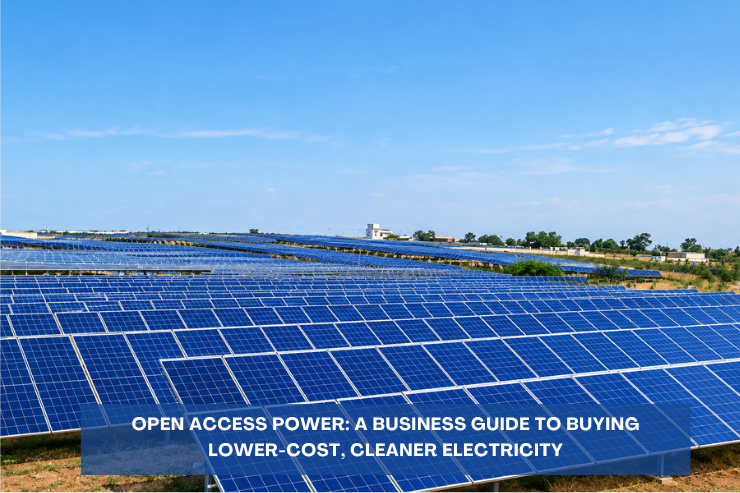


Businesses with high electricity consumption have more options today than they did in the past, beyond simply relying on conventional power supply arrangements. Open-access power can give eligible commercial and industrial consumers greater choice in sourcing electricity, including from renewable energy projects. The right arrangement can influence both the cost and the renewable energy mix of a business. Understanding how open-access electricity works, the associated charges, and the available procurement models can help businesses assess whether it fits their energy requirements.
What Is Open Access Power and How Does It Work?
Open access allows eligible consumers to procure electricity from a generator or other eligible source while using the transmission and distribution network. In India, open access in power sector arrangements allows qualifying consumers to access electricity from sources other than their usual supply arrangement, subject to applicable rules and regulations. An open-access arrangement may involve a power purchase agreement that defines pricing, supply, tenure, and other agreed terms. Electricity generated by the project is delivered through the grid, while applicable metering, scheduling, and energy-accounting arrangements determine the electricity supplied to the consumer.
How Can Open Access Help Businesses Lower Electricity Costs?
Open access allows businesses to evaluate electricity procurement beyond their regular supply arrangement. The financial outcome depends on the contracted energy price, applicable grid charges, consumption profile, location, contract terms, and state regulations. The main cost components businesses can evaluate include:
- Generation Tariff: The agreed price of electricity from the generator forms the starting point for calculating the overall procurement cost.
- Transmission Charges: These charges apply to the use of applicable transmission infrastructure to deliver electricity through the grid.
- Wheeling Charges: Distribution network charges may apply when electricity travels through a distribution licensee’s system before reaching the business facility.
- Cross-Subsidy Surcharge: Eligible open-access transactions may incur this surcharge in accordance with applicable regulations and the consumer category involved.
- Banking and Related Charges: Applicable regulations may allow eligible renewable energy to be banked and adjusted against consumption within specified banking cycles, subject to applicable conditions and charges.
- Landed Electricity Cost: Businesses can assess the contracted energy price alongside applicable network charges, surcharges, duties, losses, and other costs to estimate the effective cost of delivered electricity.
Comparing this landed cost with the business’s existing electricity expenses provides a practical basis for assessing potential financial benefits from open access. For more insights on Solar Open Access in Karnataka
How Does Open Access Help Businesses Buy Cleaner Electricity?
Businesses can use open-access renewable energy to procure electricity from off-site solar, wind, or hybrid projects. This arrangement expands renewable procurement beyond on-site generation and can help companies increase the proportion of cleaner electricity within their energy mix. India’s green open access framework supports eligible consumers seeking green energy through open access. Under the current central rules, consumers with contracted demand or sanctioned load of 100 kW or more can qualify, subject to the applicable conditions.
Open Access or Rooftop Solar: Which Option Fits a Business?
Both off-site renewable procurement and commercial rooftop solar can help businesses increase their use of clean electricity. The appropriate route depends on energy demand, available space, investment preferences, location, and applicable regulations. Some useful factors for comparing these approaches are:
- Project Location: Open-access solar generally comes from an off-site project and reaches the consumer via the grid, whereas rooftop systems generate electricity on-site.
- Available Space: Solar panels for commercial buildings use available rooftop space, making roof size, condition, orientation, and usable area important considerations during project planning.
- Electricity Requirements: Open-access procurement can complement onsite generation when a business requires renewable electricity beyond what its premises can generate.
- Ownership Preference: Under a capex model, the consumer generally funds the solar asset and retains ownership, subject to the specific project and contractual structure.
- Third-Party Investment: A solar opex model can enable a renewable-energy provider to finance and operate the project. At the same time, the consumer pays for the electricity generated under agreed-upon commercial terms.
Businesses can assess both approaches against their consumption patterns and energy objectives. As per the latest industry data Solar Open Access in Maharashtra
What Should Businesses Check Before Choosing Open Access?
An open-access decision works best when businesses examine their electricity requirements alongside the applicable regulatory and commercial framework. Each state may have specific rules, charges, procedures, and energy-accounting provisions. Key considerations for evaluating an open-access arrangement include:
- Eligibility Requirements: Businesses should verify whether their contracted demand or sanctioned load meets the applicable open-access eligibility criteria for their location and proposed transaction.
- Consumption Profile: Reviewing electricity consumption, demand patterns, and operating hours helps determine the amount and type of renewable energy supply suited to the facility.
- State Regulations: State Electricity Regulatory Commission rules can influence approvals, charges, banking provisions, energy accounting, and other aspects of procurement.
- Renewable Source: Solar, wind, and hybrid projects have different generation profiles, allowing businesses to assess the source against their electricity consumption patterns.
- Project and Grid Location: The location of the generation project and consumer influence transmission arrangements, applicable charges, losses, and regulatory requirements. At Hero Future Energies, we support C&I customers with renewable energy solutions tailored to their project and grid requirements, including open-access, hybrid, and round-the-clock power solutions integrated with battery storage.
- Commercial Terms: Contract duration, contracted energy price, scheduled supply, payment terms, and other agreed-upon provisions warrant careful assessment before finalising the procurement.
- Total Landed Cost: Combining the contracted energy price with applicable transmission, wheeling, surcharges, duties, losses, and related components provides a clearer financial picture.
At Hero Future Energies, we provide onsite and offsite renewable energy solutions for commercial and industrial consumers, including Solar Open Access, Wind Open Access, and Solar-Wind Hybrid Open Access. Our offsite renewable-energy solutions through open access can help C&I consumers meet 70% to 80% of their energy requirements from green sources, subject to the applicable project and consumer conditions.
Conclusion
Open access gives eligible businesses another route to procure electricity while choosing renewable sources that align with their energy goals. It supports cost planning by allowing companies to evaluate generation prices alongside grid and regulatory charges. A sound decision considers total landed electricity cost, consumption patterns, state rules, renewable sources, and contract terms together. By comparing these factors with existing supply arrangements and on-site alternatives, businesses can identify an electricity procurement approach supporting both operational requirements and cleaner-energy objectives.
Frequently Asked Questions
1. Who can use open access electricity?
Eligible commercial and industrial consumers can use open access electricity, subject to applicable central and state regulations, sanctioned load or contracted demand, and other eligibility conditions.
2. What is the difference between open access electricity and commercial rooftop solar?
Open access supplies electricity from an off-site power project through the grid, while commercial rooftop solar generates electricity directly at the business premises.
3. Is solar open access cheaper than grid electricity?
Solar open access can offer cost benefits when the total landed electricity cost is lower than the existing supply cost. Savings depend on tariffs, transmission charges, surcharges, losses, and state regulations.
4. What is a Power Purchase Agreement (PPA)?
A Power Purchase Agreement (PPA) is a contract between a power producer and buyer that defines terms such as electricity price, supply, tenure, and other commercial conditions.
5. What is the CAPEX model in renewable energy?
Under the CAPEX model, the business invests in and typically owns the renewable energy system, while being responsible for its associated development, operation, and maintenance arrangements.
6. What are the charges involved in open access electricity?
Open access electricity may involve generation tariffs, transmission and wheeling charges, cross-subsidy surcharge, losses, banking charges, duties, and other applicable regulatory costs.
7. How is the cost of open access electricity calculated?
The cost is assessed by combining the contracted generation tariff with applicable transmission, wheeling, surcharges, losses, duties, banking charges, and other costs to determine the landed electricity cost.
8. Can businesses combine rooftop solar with open access power?
Yes, businesses can combine rooftop solar with open access procurement when permitted by applicable regulations, helping meet renewable electricity requirements beyond onsite generation.