

What is solar open access in India?
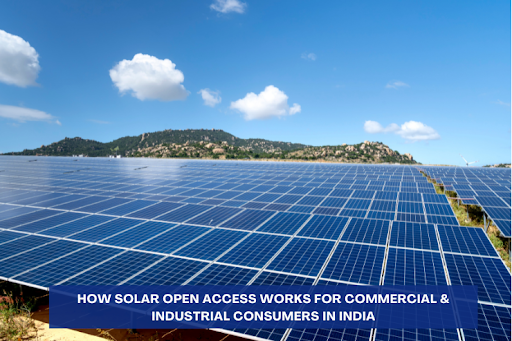
Solar open access lets your business buy solar electricity directly from a renewable power developer instead of the state DISCOM (Distribution Company). Power is generated at an offsite solar park and delivered to your facility through the existing grid, with precise energy accounting on your meter.
Illustration
An auto components manufacturing company in Manesar, Haryana, with a connected load of 15 MW connected at 66KV, signs a 25-year PPA with a solar developer for a 5MW solar project at ₹3.95/unit energy charges and a landed tariff of ₹4.78/unit, including all state charges. Their current DISCOM landed rate is ₹7.32/unit. Effective saving ₹2.44/unit/ across millions of units consumed, thus enabling approx. 30% savings on annual power consumption.
Who can apply for solar open access?
Any commercial or industrial consumer with a contracted demand of 100 kW or above can typically apply under India’s Green Open Access Rules. There is no minimum contracted demand for captive /group captive consumers. The sweet spot is high-consumption businesses with predictable load profiles:
- Manufacturing plants (auto, steel, cement, textiles, chemicals, pharma and paper)
- Data centres and IT Parks
- Hospitals and healthcare institutions
- Warehouses, cold storage and logistics hubs
- Shopping malls and commercial complexes
State-level rules vary. Always verify eligibility criteria with your respective SERC before proceeding.
What is the minimum load requirement?
Under the Green Open Access Rules 2022, the central threshold is a contracted demand of at least 100 kW. Previously, this was 1 MW, making open access far more accessible for mid-size businesses.
- Check your DISCOM bill for ‘Contract Demand’ — If 100 kW or above, you likely qualify
- Verify state-level thresholds — Some states still apply higher limits
- Aggregate multiple facilities — In some states, combined demand across sites can meet the threshold
Also Read: The Challenges and Solutions in Scaling up Renewable Energy
How does open-access solar actually work?
Think of it as reserving capacity in a large solar farm. Here’s the four-step journey your electricity takes:
- Generate: Developer builds and operates a utility-scale plant (10–200 MW) in a high-irradiance zone like Rajasthan or Gujarat.
- Inject: Power flows into the state/central grid via high-voltage transmission lines.
- Account: Energy accounting systems track the exact units generated against your PPA allocation. Consumer/ offtaker has to install an ABT (Availability Based Tariff) meter at their point of consumption.
- Consume & bill: You draw from the grid normally (No change in the drawal mechanism). Your bill reflects open-access units at PPA rates plus applicable grid charges.
What charges are involved?
Beyond the PPA tariff, you’ll pay a set of grid charges. These vary by state but typically include:
| Charge | What It Covers |
| Wheeling charges | Using the distribution network |
| Transmission charges | Using HV transmission lines |
| Cross-subsidy surcharge (CSS) | Compensates DISCOMs for lost revenue |
| Banking charges | Storing surplus units for later use |
| STU/CTU charges | State/central transmission utility fees |
NET SAVING ILLUSTRATION — MAHARASHTRA
DISCOM rate: ₹9.50/unit | PPA + all charges: ~₹5.80/unit → Net saving of ₹3.70/unit. For a 1 MW consumer, that’s approximately ₹2 Cr saved annually, considering 40% power replacement via Solar/ Green Power.
How does captive / group captive solar open access work?
In captive open access, your business co-owns a stake (typically 26%) in the solar project. This often unlocks reduced or waived cross-subsidy surcharges and additional surcharges, delivering the lowest total cost of energy.
What is solar open access in India?
- 26% ownership stake in the plant
- ASS & CSS waiver or reduction in most states
- Lowest long-term electricity cost
- Higher initial commitment
- Best for 5 MW+ consumers
Learn More: Understanding Solar Renewable Energy: Benefits and Applications
What is solar open access in India?
For most C&I consumers in India, yes — by a significant margin. Industrial tariffs in Maharashtra, Gujarat, Haryana, and Karnataka are in the range of ₹7–10/unit. Competitive PPA rates for open access solar typically land at ₹3.50–4 in terms of energy charges and enable savings of 25-30% on an annual basis.
What is solar open access in India?
Moved 60% of load (1.8 MW) to open access solar. Annual electricity bill dropped from ₹18.7 Cr to ₹11.4 Cr — a net saving of ₹7.3 Cr/year. Payback on advisory and connection costs: under 6 months.
Actual savings depend on state, load profile, contracted duration, and applicable charges. Always request a site-specific financial assessment before signing a PPA.
What is solar open access in India?
Both solve different problems. Many large consumers combine both for maximum impact.
| Rooftop solar | Solar open access |
|
|
Best practice: Deploy rooftop solar for daytime base load, layer open access for additional demand, and add battery storage to reduce peak grid draw. This hybrid approach typically maximises RE percentage and minimises overall tariff.
POLICY & REGULATION
Are government policies supporting solar open access?
Yes — the regulatory direction is strongly supportive. Three key pillars:
- Green Open Access Rules 2022: Reduced the minimum eligibility threshold from 1 MW to 100 kW and mandated 15-day approval timelines, significantly lowering barriers.
- RPO obligations: Rising Renewable Purchase Obligations make open access a compliance tool, not just a cost play.
- Carbon Credit Trading Scheme: India’s emerging carbon market allows businesses to monetise their renewable energy use.
State implementation varies. Some states have yet to fully align with central Green Open Access Rules — consult your SERC or a certified open access advisor.
Which Industries benefit most from C&I renewable energy?
Industries with high, continuous power consumption and sensitivity to energy costs gain the most. ESG-driven sectors and export-oriented manufacturers are increasingly mandating renewable sourcing through their supply chains.
- Textiles & apparel (energy is 15–20% of production cost)
- Automotive & auto components
- Chemicals, pharma & specialty materials
- Food & beverage processing
- Data centres (power is the dominant OpEx)
- Steel, cement & heavy industry
- Paper, packaging & printing
Related Insights: Role of Solar Open Access in Maharashtra: A Comprehensive Guide
EXPORT-DRIVEN MOTIVATION
A garment exporter supplying European brands was required to report Scope 2 emissions. Shifting 80% of the load to open access solar reduced their carbon intensity and helped retain two major buyers with green sourcing mandates. Most large organizations also consider managing the Scope 3 emissions for their value chains as well.
Can commercial buildings use solar open-access power?
Yes — IT parks, malls, hotels, hospitals and large commercial complexes are among the fastest-growing open access consumers. The key requirements are a contracted demand of 100 kW or above and HT (high-tension) consumer classification.
IT PARK, Karnataka — 4 MW PEAK DEMAND
Procured 5 MW via open access PPA, combined with 800 kW rooftop solar. Now sources 72% of electricity from renewables — a core metric for LEED Platinum certification renewal.
Related Insights: Solar Power Energy Projects: What You Need to Know Before You Start?
GETTING STARTED
Recommended next steps
- Check your eligibility: Review 12 months of electricity bills for your Contract Demand and average monthly units consumed.
- Run a financial model: Request a site-specific savings assessment from a certified open access developer or advisor.
- Verify state rules: Confirm applicable open access charges, approval timelines and banking policies with your SERC.
- Evaluate captive vs third-party: If your load exceeds 5 MW, captive ownership often delivers better TCO through CSS savings.
Frequently Asked Questions
What is the minimum load requirement for open access?
Under Green Open Access Rules, consumers with a contracted demand of at least 100 kW can usually apply for open access.
How does captive solar open access work?
Captive solar open access allows businesses to consume electricity from renewable energy projects in which they hold partial ownership.
What are the charges involved in solar open access?
Charges may include wheeling fees, transmission charges, banking charges, cross-subsidy surcharges, and other state-specific regulatory costs.
What is the difference between rooftop solar and solar open access?
Rooftop solar generates electricity on-site, while solar open access supplies renewable power from off-site solar projects through the grid.
Are government policies supporting solar open access in India?
Yes, India’s Green Open Access Rules and renewable energy policies support wider adoption of solar open access across commercial and industrial sectors.