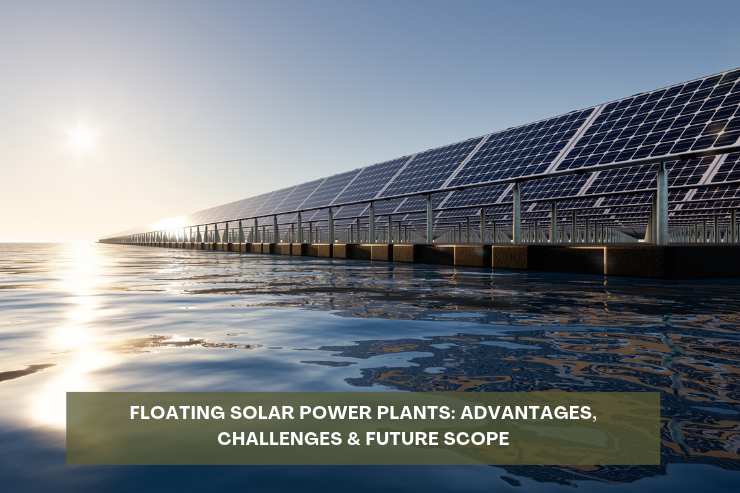


A floating solar power plant uses photovoltaic panels on anchored platforms over reservoirs, lakes, or industrial ponds. It can generate electricity without occupying the land required by a conventional solar installation, although the water body must be suitable for the project.
India had approximately 700 MW of floating solar capacity in mid-2026. In July 2026, the government approved the Pradhan Mantri Surya Sarovar Yojana, which supports another 5,000 MW of floating solar projects with co-located storage.
What Is a Floating Solar Power Plant?
A floating solar power plant generates electricity using solar panels mounted on floating platforms over water bodies such as reservoirs, lakes, and ponds. Its main components and working process include:
- Understanding Floating Solar Technology: Photovoltaic (PV) panels sit on buoyant platforms anchored over water. Floating PV generates clean power like land-based solar while freeing up land.
- How a Floating Solar Power Plant Works: Panels produce direct current (DC) electricity, which inverters convert to alternating current (AC) before cables carry it to a nearby substation and the grid.
Key Components of a Floating Solar Power Plant
A floating installation requires equipment designed to operate safely on water. The main components include:
- Floating Platforms and Structures: High-density polyethylene (HDPE) floats support panels and resist corrosion and sun damage.
- Solar Panels and Mounting Systems: Panels sit at a low tilt to reduce wind load.
- Anchoring and Mooring Systems: Anchors and mooring lines hold the array in place as wind, waves, and water levels change.
- Electrical Components and Grid Connection: Floating or underwater cables, inverters, and transformers connect the plant to the grid.
Advantages of Floating Solar Power Plants
Compared with land-based projects, floating solar can offer several site-specific advantages:
- Efficient Use of Available Space: Reservoirs and industrial ponds may provide usable installation space where land is expensive or limited.
- Improved Solar Panel Efficiency: Water keeps panels slightly cooler, with research showing modest gains of about 0.5% to 3%.
- Reduced Water Evaporation: Panels shade the water, reducing evaporation from covered areas.
- Reduced Land Acquisition Requirements: Floating plants avoid competing with farms, forests, and housing.
- Renewable Energy Generation: Each project adds clean electricity and supports national renewable targets.
Challenges of Floating Solar Power Plant Installation
Before development, the following constraints require careful assessment:
- High Initial Installation Costs: Floats, anchoring, and specialized cabling make floating plants costlier than ground-mounted ones.
- Technical and Maintenance Challenges: Crews need boats or walkways for cleaning and servicing, and algae can build up on structures.
- Environmental Impact on Aquatic Ecosystems: Shading cuts sunlight below the surface and can affect aquatic plants, fish habitats, and fishing communities.
- Weather and Structural Risks: Strong winds, storms, and changing water levels stress floats, anchors, and cables.
- Grid Connectivity Challenges: Many reservoirs sit far from substations, raising transmission costs.
Site assessments should include water depth, seasonal reservoir levels, wind exposure, shoreline access, and cable routing. Developers must also consider existing water uses before selecting the array location.
Read more about Solar Open Access Works for Commercial & Industrial
Floating Solar Power Projects in India
Several projects and policy measures illustrate the opportunity:
- Growth of Floating Solar in India: The National Institute of Solar Energy estimates India’s potential across reservoirs and inland water bodies at about 102 gigawatt-peak (GWp).
- Major Floating Solar Projects in India: The Omkareshwar project in Madhya Pradesh targets 600 MW, with 278 MW operating after its first phase. Other major floating solar projects include NTPC’s 100 MW Ramagundam plant in Telangana and the 92 MW Kayamkulam plant in Kerala.
- Government Support and Renewable Energy Initiatives: In July 2026, the Cabinet approved the ₹5,070 crore Pradhan Mantri Surya Sarovar Yojana, which offers ₹1 crore per MW for floating solar paired with battery storage.
For more insights on Solar Power Energy Projects
Floating Solar vs Ground-Mounted Solar Power Plants
The two approaches differ in site requirements and operations:
| Parameter | Floating Solar | Ground-Mounted Solar |
| Installation Location | Water bodies | Land |
| Land Requirement | Minimal additional land | Large land area |
| Installation Cost | Generally higher | Generally lower |
| Cooling Effect | Natural water cooling potential | Depends on environmental conditions |
| Maintenance | More complex water-based maintenance | Relatively accessible |
| Environmental Considerations | Aquatic ecosystem impact | Land-use impact |
Future Scope of Floating Solar Power Plants
Floating solar has strong long-term potential. Below are the areas illustrating future scope:
- Growing Demand for Floating Solar Projects: Reservoirs across Maharashtra, Madhya Pradesh, Karnataka, Odisha, and Telangana hold much of India’s floating solar potential.
- Technological Advancements in Floating PV: Better float materials, higher-efficiency modules, smart monitoring, and stronger anchoring keep improving reliability.
- Floating Solar’s Role in India’s Renewable Energy Goals: Floating systems can complement rooftop and ground-mounted solar.
These trends support steady growth in floating solar in India. Among the onsite options offered to commercial and industrial customers, Hero Future Energies provides rooftop and ground-mounted systems.
For more insights on Choose the Best Solar Power Solution
Conclusion
A floating solar power plant turns reservoirs and ponds into sources of clean electricity while saving valuable land. Its key advantages include efficient space use, lower water evaporation, and modest performance gains from water’s natural cooling effect.
Higher costs, complex maintenance, and environmental concerns require careful planning. With a national scheme, operating projects, and an estimated 102 GWp of potential, floating solar can play a growing role in India’s renewable energy future and global clean energy efforts.
Frequently Asked Questions
1. How does a floating solar power plant work?
Panels fixed to floating, anchored structures generate DC electricity. Inverters convert it to AC for onsite use or supply to the grid.
2. What are the major advantages of floating solar power plants?
Key advantages include land savings, lower evaporation, modest cooling-related efficiency gains, and clean power generation.
3. What are the challenges of floating solar installations?
Challenges include higher costs, complex maintenance, impacts on aquatic ecosystems, weather risks, and grid-connectivity limits.
4. How much does it cost to install a floating solar power plant?
Costs depend on water depth, anchoring, access, grid connections, and project scale. Site-specific engineering estimates are more useful than a single national price.
5. What are some major floating solar projects in India?
Major projects include Omkareshwar in Madhya Pradesh, Ramagundam in Telangana, and Kayamkulam in Kerala.
6. Is floating solar more efficient than ground-mounted solar?
Cooling can improve performance under some conditions, but the actual difference from ground-mounted solar varies by site.
7. What is the future scope of floating solar in India?
A 2026 government scheme supports 5,000 MW of floating projects with storage, while NISE estimates potential of about 102.18 GWp.
8. What is the difference between floating solar and floating PV?
Both terms describe the same technology; floating PV refers to the photovoltaic panels used.